Perceptual maps for gait analysis
Master's, Université de Montréal · 2012–2014
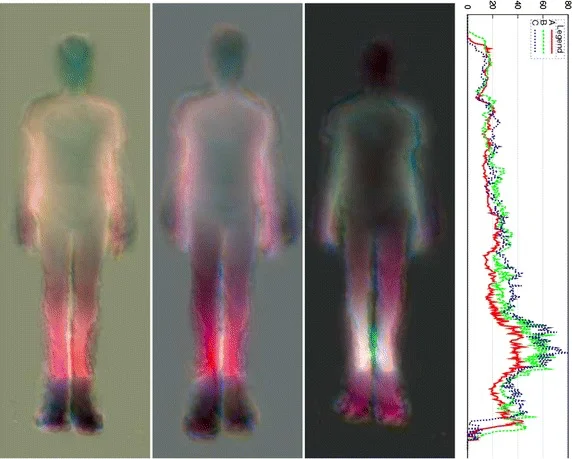
Gait analysis supports the diagnosis of many neurological, muscular or orthopedic conditions. The goal was an inexpensive, easy-to-use clinical tool built on an affordable consumer depth sensor, the Kinect, to measure gait asymmetry and display it in a perceptual way.
The method relies on the temporally shift-invariant symmetry of healthy gait in the coronal plane. A multidimensional scaling mapping, based on a temporally shift-invariant distance, produces a color map in which perceived color differences reveal the body parts that move asymmetrically. An index computed from this map quantifies asymmetry locally and globally.
The index proved statistically significant. The system, marker-less, non-invasive and easy to set up, gives clinicians a quick overview of asymmetry, useful to follow disease progression or recovery after surgery.
Publications and links
- Journal article, BioMedical Engineering OnLine, 2015 — A perceptual map for gait symmetry quantification and pathology detection
- Conference proceedings, IEEE EMBC, 2014 — Evaluating perceptual maps of asymmetries for gait symmetry quantification and pathology detection
- Master's thesis, Université de Montréal, 2014 — Evaluating perceptual maps of asymmetries for gait symmetry quantification and pathology detection